
A Practical Guide to the Mackenzie Shirilla Case
Mackenzie Shirilla: What Happened and Where the Case Stands
Mackenzie Shirilla is serving two concurrent sentences of 15 years to life for a 2022 car crash in Strongsville, Ohio, that killed her boyfriend, Dominic Russo, and their friend Davion Flanagan. Prosecutors argued that she drove her Toyota Camry into a building on purpose; Shirilla maintains that the crash was not intentional. She is eligible for parole in October 2037.
As of October 2026, the case is drawing fresh attention because of Netflix’s The Crash, newly released messages and jail calls, and her ongoing legal challenge. This guide separates what the court decided from what Shirilla and her attorneys still dispute, while also examining how the case has influenced public conversations about digital forensics, vehicular homicide prosecutions, and true-crime media coverage.
The legal proceedings have raised difficult questions about how courts weigh event data recorder evidence against claims of medical emergencies, and about how much weight should be given to a defendant’s text message history when establishing intent. For readers following the case through documentary coverage, understanding the distinction between the trial record and the postconviction arguments is essential. The sections below walk through the crash investigation, the trial evidence, the conviction, Shirilla’s current prison status, and the appeals that are still working their way through the Ohio court system.
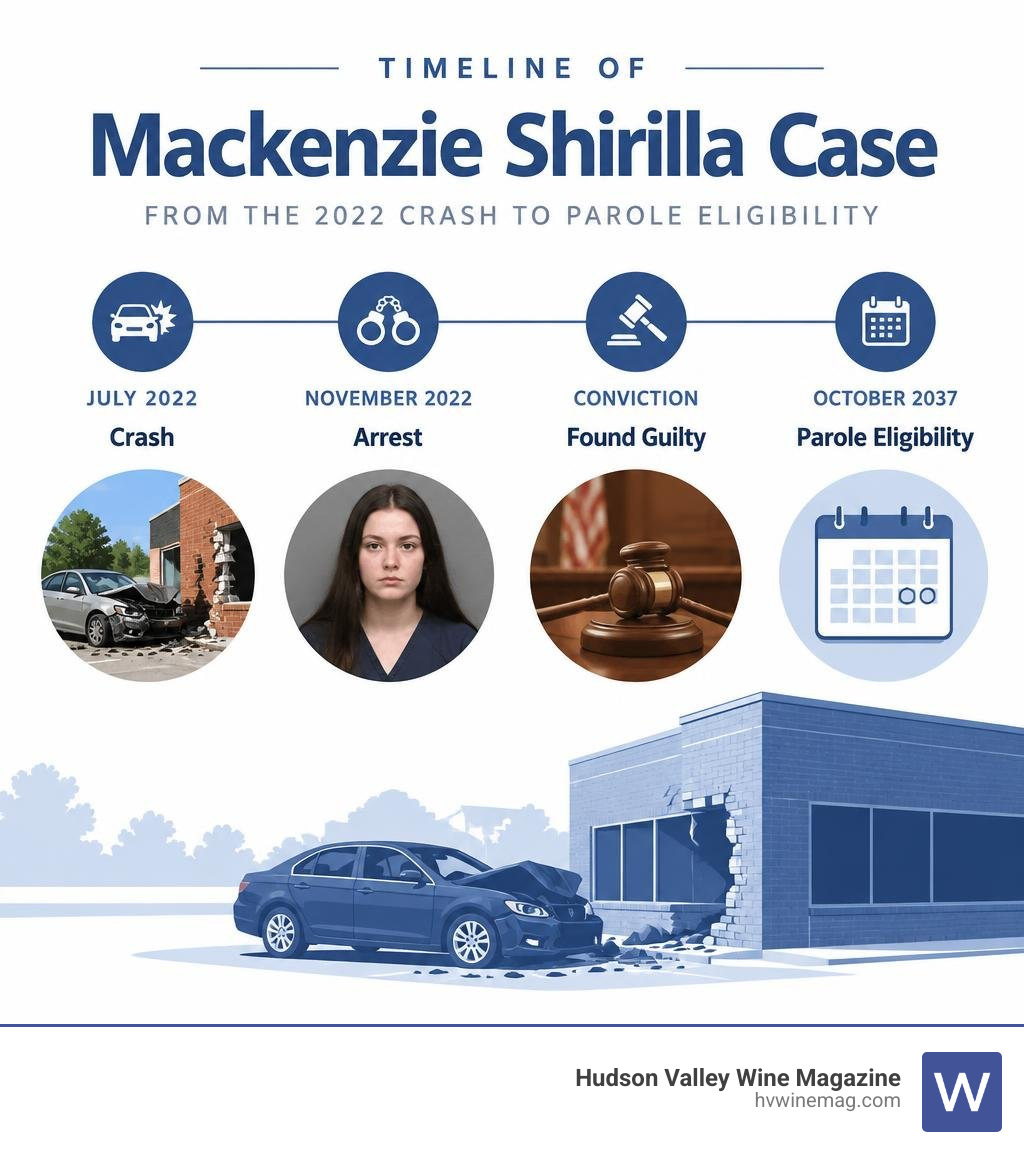
Fatal Crash Details and Initial Investigation
The tragedy unfolded in the early morning hours of July 31, 2022, inside the Progress Drive Business Park in Strongsville, Ohio. Mackenzie Shirilla, who was 17 years old at the time, was behind the wheel of her 2007 Toyota Camry carrying her 20-year-old boyfriend, Dominic Russo, and 19-year-old passenger Davion Flanagan.
According to collision reconstruction experts, the vehicle accelerated aggressively down a narrow industrial park roadway, reaching speeds of nearly 100 mph before slamming directly into the corner of a brick commercial building. Russo and Flanagan died instantly upon impact, while Shirilla survived with serious injuries. The force of the collision was so severe that first responders initially had difficulty determining how many people had been inside the vehicle, and the wreckage required extensive documentation before the scene could be cleared.
The physical evidence from the scene immediately raised red flags for crash investigators. Forensic telemetry retrieved from the Camry’s event data recorder showed that the accelerator pedal was pressed down to 100% just seconds prior to impact, with zero brake application recorded. Investigators also noted that the vehicle’s path through the business park did not suggest a driver who had lost control or was attempting to avoid a hazard. Instead, the Camry traveled in a relatively straight line toward the building, with no evidence of evasive steering or corrective maneuvers in the final moments before impact.
Despite the catastrophic nature of the wreck, charges were not brought right away while investigators conducted thorough digital, vehicular, and toxicological analyses. Following those extensive inquiries, official details on when Mackenzie Shirilla was arrested confirmed that law enforcement took her into custody on November 4, 2022—more than three months after the collision occurred. Toxicology reports revealed cannabis in her system at the time of the crash, though prosecutors focused heavily on vehicle data rather than standard impairment. The delay between the crash and the arrest allowed investigators to reconstruct the vehicle’s movements, analyze the event data recorder, and review extensive phone records before filing charges.
Key Evidence in the Mackenzie Shirilla Investigation
To build a case of intentional murder rather than reckless driving, prosecutors assembled a digital trail documenting the fraught relationship between Shirilla and Russo. The state presented evidence showing intense volatility, explosive arguments, and previous threats. Investigators also examined the couple’s social media activity, call logs, and location data to establish a pattern of behavior in the weeks leading up to the crash.
Among the central pieces of digital evidence were newly released text messages that shed light on Shirilla’s state of mind leading up to the tragedy. In one message sent to Russo weeks before the collision, she wrote, “treat the girl who would die for you a little better.” Other communications revealed severe emotional distress and statements referencing suicidal intent, including texts declaring “THIS IS WHY I J WANNA F—ING KMS.” Prosecutors argued that these messages, combined with the vehicle telemetry, painted a picture of a young woman in crisis who had expressed both despair and anger toward Russo in the period before the crash.
Police bodycam footage gathered from both the hospital and post-arrest interactions further documented erratic behavior. Officers who spoke with Shirilla in the hospital noted that her statements about the crash were inconsistent with the physical evidence, and her demeanor during subsequent interviews raised additional questions about her account of what had happened. Cuyahoga County Common Pleas Court Judge Nancy Margaret Russo ultimately determined that the vehicle’s calculated path through the business park and the deliberate lack of braking demonstrated a controlled “mission” to cause catastrophic harm rather than a reckless teenage accident. The judge’s written findings emphasized that the accelerator data, the steering inputs, and the absence of any braking were not consistent with a driver who had suffered a sudden medical emergency or who had simply lost control of the vehicle.
The Mackenzie Shirilla Trial and Murder Conviction
In August 2023, following a high-profile bench trial in Cuyahoga County, Judge Russo found Shirilla guilty on all 12 felony counts. The convictions included four counts of murder, four counts of felonious assault, two counts of aggravated vehicular homicide, one count of drug possession, and one count of possessing criminal tools (the vehicle itself). Because Shirilla waived her right to a jury trial, Judge Russo alone heard the evidence, evaluated the credibility of expert witnesses, and issued the verdict.
The legal community closely followed the bench trial for its rare use of intentional murder charges in a vehicular collision setting; our comprehensive trial verdict analysis covers the evidentiary threshold required for those convictions. Legal analysts noted that prosecutors typically pursue vehicular homicide or manslaughter charges in fatal crash cases, making the murder convictions in this case particularly significant. The state’s ability to convince the judge that Shirilla had formed the intent to kill before the crash relied heavily on the event data recorder evidence and the text message history, rather than on any single piece of direct testimony.
Judge Russo sentenced Shirilla to two concurrent terms of 15 years to life in prison, setting her earliest parole eligibility date for October 2037. The concurrent sentences mean that she is serving both murder terms at the same time, but the life tail on each sentence means that parole is not guaranteed even after the minimum 15 years have been served. At the sentencing hearing, family members of Russo and Flanagan delivered victim impact statements describing the loss of their loved ones and the ongoing grief caused by the crash.
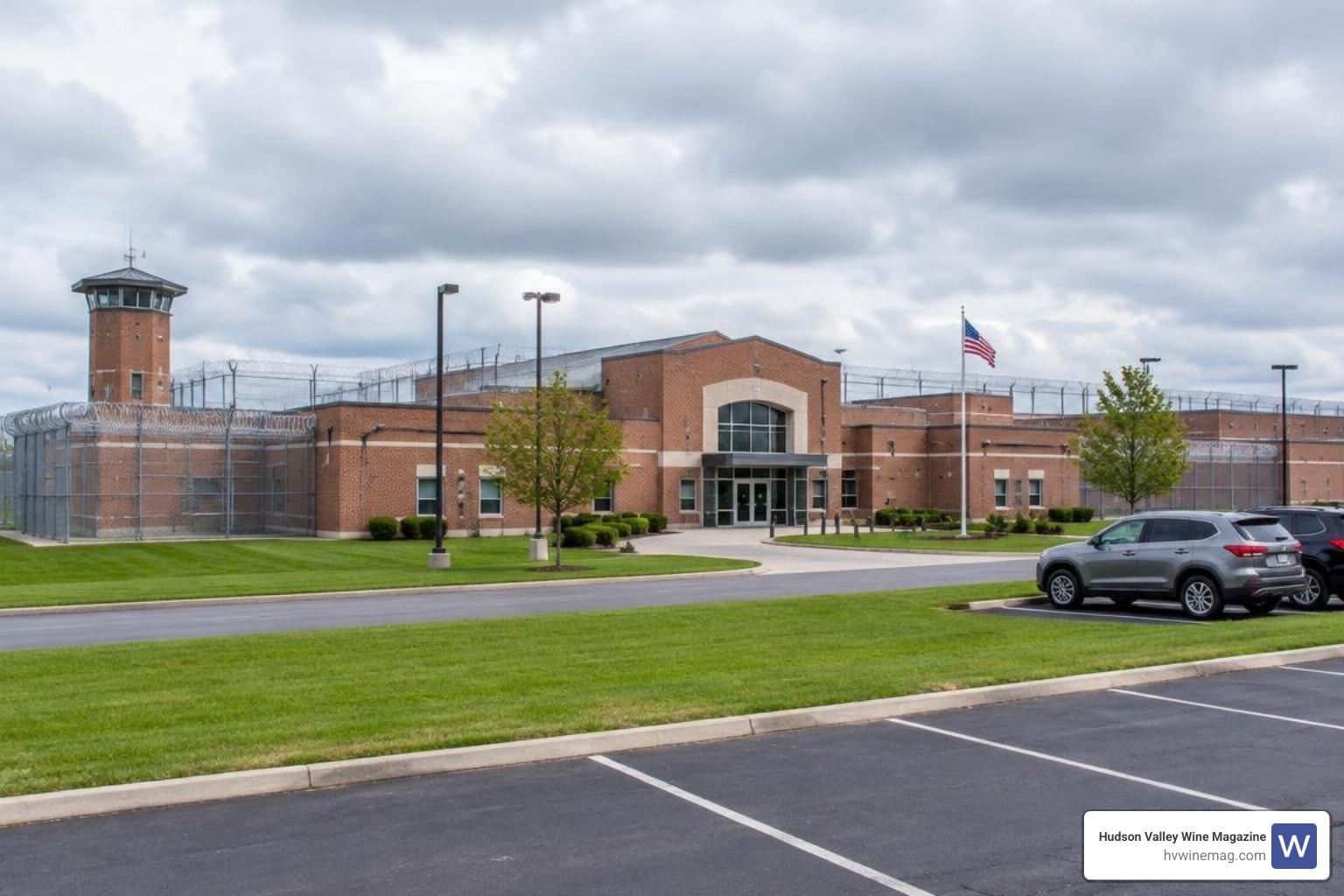
Mackenzie Shirilla Prison Life and Current Status
Shirilla is currently serving her sentence at the Ohio Reformatory for Women in Marysville, Ohio. Adjusting to life inside a state correctional facility, she has transitioned into institutional support programs. The facility, which houses female inmates from across the state, offers educational programming, vocational training, and work assignments designed to prepare incarcerated individuals for potential reintegration into society.
Reports on her daily routine confirm that her inmate kitchen assignment involves preparing and serving daily meals to other incarcerated women. Under Ohio state correctional guidelines, inmates assigned to food service must complete required medical screenings to verify health compliance, earning standard institutional stipends that top out at around $24 per month. Prison officials have not commented publicly on Shirilla’s behavior or disciplinary record, but her placement in a food service role indicates that she has met the basic requirements for institutional work assignments and has maintained a sufficient level of compliance to be eligible for the position.
Legal Appeals, Medical Defenses, and Documentary Scrutiny
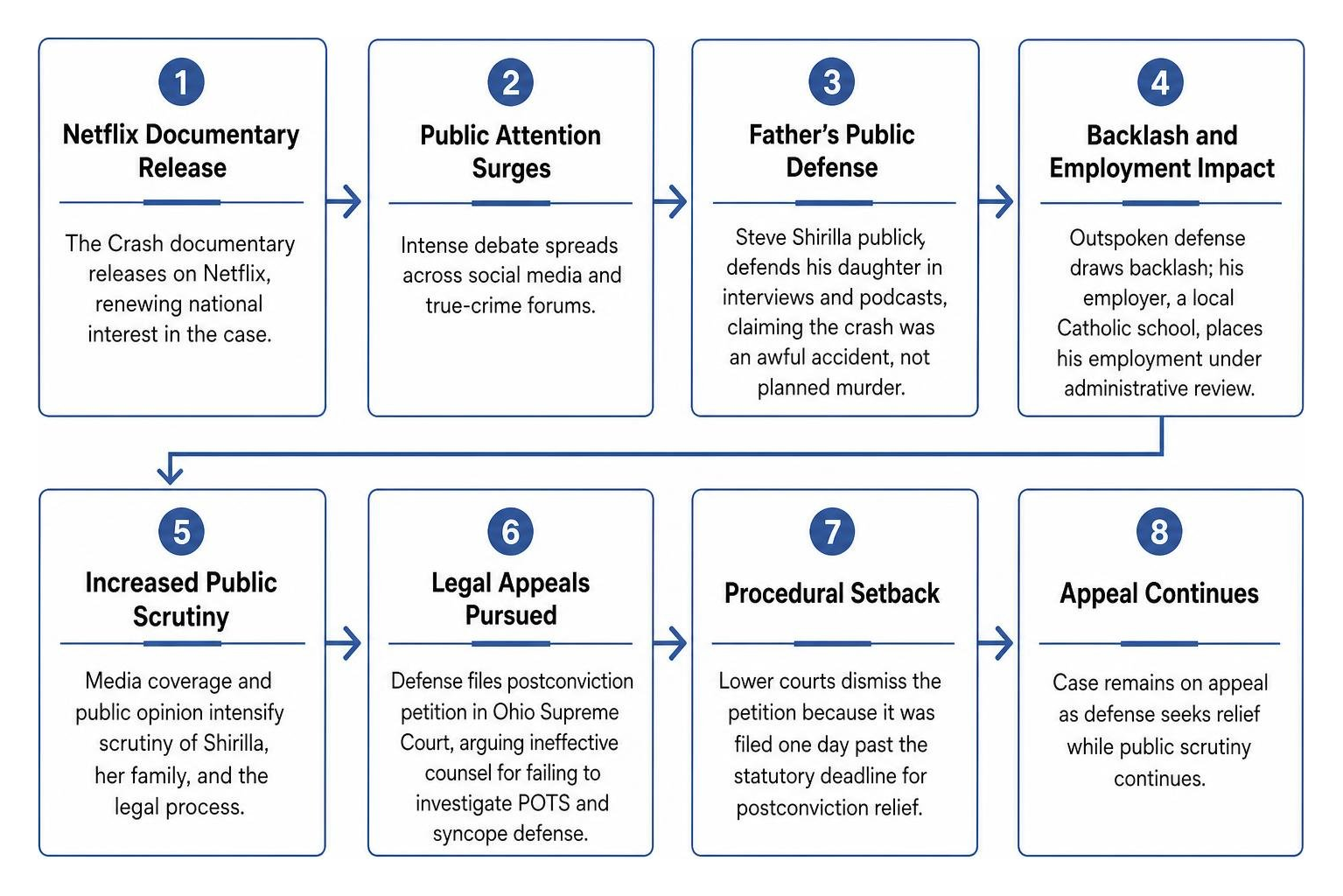
Shirilla’s defense team has pursued multiple postconviction avenues, eventually taking their petition to the Ohio Supreme Court. Central to her postconviction claim is the argument that her original trial counsel failed to investigate a medical condition: Postural Orthostatic Tachycardia Syndrome (POTS). The defense argues that this condition, which can cause rapid heart rate, dizziness, and fainting upon standing or during periods of stress, was never properly evaluated before trial and could have provided an alternative explanation for the crash.
Her appellate attorneys assert that a sudden POTS-induced syncope or blackout episode could explain her physical incapacitation and pedal engagement just before the crash. Under this theory, Shirilla may have lost consciousness with her foot pressed against the accelerator, making the 100% throttle input an involuntary physical response rather than a deliberate act. However, the appeal ran into severe procedural hurdles when lower courts dismissed her postconviction relief petition because it was filed one day past the statutory filing deadline. Ohio law imposes strict time limits on postconviction petitions, and courts have generally held that even minor delays can bar consideration of the underlying claims unless the defendant can demonstrate a valid reason for the late filing.
| Legal Claim / Defense Point | Prosecution Case & Physical Evidence | Appellate & Defense Argument |
|---|---|---|
| Driver Intent | Telemetry showed 100% accelerator depression, zero braking, deliberate steering. | A medical syncope episode (POTS blackout) caused involuntary muscle lock and loss of consciousness. |
| Relationship Motive | Text history showing threats, relationship volatility, and suicidal statements. | Messages reflected typical teenage emotional outbursts rather than premeditated murder planning. |
| Procedural Appeal | Petition was filed one day beyond the strict Ohio statutory deadline for postconviction relief. | The minor filing delay should be excused given claims of ineffective assistance of trial counsel. |
The Ohio Supreme Court has not yet indicated whether it will accept the case for review. If the court declines to hear the appeal, Shirilla’s remaining legal options would be limited to federal habeas corpus review, which carries its own strict procedural requirements and a high bar for relief. Legal observers have noted that the one-day filing delay may prove difficult to overcome, as Ohio courts have historically applied postconviction deadlines strictly even in cases involving serious felony convictions.
Public Defense and Netflix Documentary Fallout
The release of Netflix’s true-crime documentary The Crash renewed national interest in the tragedy, prompting intense debate across social media and true-crime forums. The documentary presented the prosecution’s evidence alongside interviews with people connected to the case, and its release led to a wave of online discussion about whether the crash was a deliberate act or a tragic accident. Viewers have debated the significance of the event data recorder evidence, the text messages, and the medical defense that was not presented at trial.
Shirilla’s father, Steve Shirilla, has publicly defended his daughter in media appearances and podcasts. In a widely discussed interview, his father’s defense statements argued that she had access to weapons if she harbored genuine homicidal intent, maintaining that the wreck was an awful accident rather than planned murder. He has also suggested that the crash investigation overlooked alternative explanations for the vehicle’s behavior and that his daughter’s medical history was not adequately explored before trial.
Steve Shirilla’s outspoken defense and media participation led his employer, a local Catholic school, to place his employment under administrative review following community backlash. The school reportedly received complaints from parents and community members who objected to his public statements about the case, and administrators placed him on leave while they reviewed the situation. The controversy highlights the broader social consequences that have extended beyond the courtroom for those connected to the case.
Frequently Asked Questions About the Case
What was Mackenzie Shirilla’s sentence and when is her earliest parole date?
Mackenzie Shirilla was sentenced in Cuyahoga County Common Pleas Court to two concurrent terms of 15 years to life for murder. She will not be eligible for her first parole hearing until October 2037. Because the sentences include a life tail, parole is not automatic at the 15-year mark; the Ohio Parole Board will evaluate her case and determine whether she is suitable for release at that time.
How did prosecutors establish intent rather than accidental reckless driving?
Prosecutors relied on telemetry data from the Camry’s black box showing that the accelerator was floored to 100% without any brake tap, combined with precise steering through the business park and historical text messages indicating suicidal ideation and volatile threats toward Dominic Russo. The absence of any evasive steering or braking, along with the vehicle’s direct path toward the building, led the judge to conclude that the crash was a deliberate act rather than a loss of control or a medical emergency.
What is the POTS defense presented in the postconviction appeal?
The defense argues that Postural Orthostatic Tachycardia Syndrome (POTS) may have triggered a sudden blackout, causing Shirilla to lose consciousness with her foot frozen on the accelerator. Lower courts rejected the petition primarily because it missed the postconviction filing deadline by one day. The defense also claims that Shirilla’s original trial attorneys were ineffective for failing to investigate the condition and present it as an alternative explanation at trial.
What role did the Netflix documentary play in the case?
Netflix’s The Crash brought renewed public attention to the case in 2026, leading to widespread discussion of the evidence and the legal proceedings. The documentary did not change the court’s rulings, but it did amplify public debate about the case and contributed to the scrutiny faced by Shirilla’s family members who spoke publicly in her defense.
Conclusion
The Mackenzie Shirilla case continues to highlight the complex intersection of digital forensics, vehicular event data, and true-crime media narratives. While documentary coverage has sparked public debate over intent versus accident, Ohio courts have repeatedly upheld the murder convictions based on the physical telemetry recovered from the scene. The case stands as a significant example of how event data recorder evidence can support intentional murder charges in a vehicular context, and it may influence how similar cases are prosecuted in the future.
The ongoing appeals process will determine whether Shirilla’s medical defense claims receive further judicial consideration, but the procedural obstacles she faces are substantial. Regardless of the ultimate outcome, the case has already left a lasting mark on legal discussions about the use of vehicle telemetry in criminal prosecutions and on public conversations about how true-crime documentaries shape perceptions of guilt and innocence.
For those looking to step away from intense legal analyses and enjoy regional travel, we recommend exploring regional cider craft at Angry Orchard to discover the historic traditions and craft beverages of the Hudson Valley.