The Ultimate Guide to the Mackenzie Shirilla Case Verdict
Mackenzie Shirilla Case: Verdict and Appeals
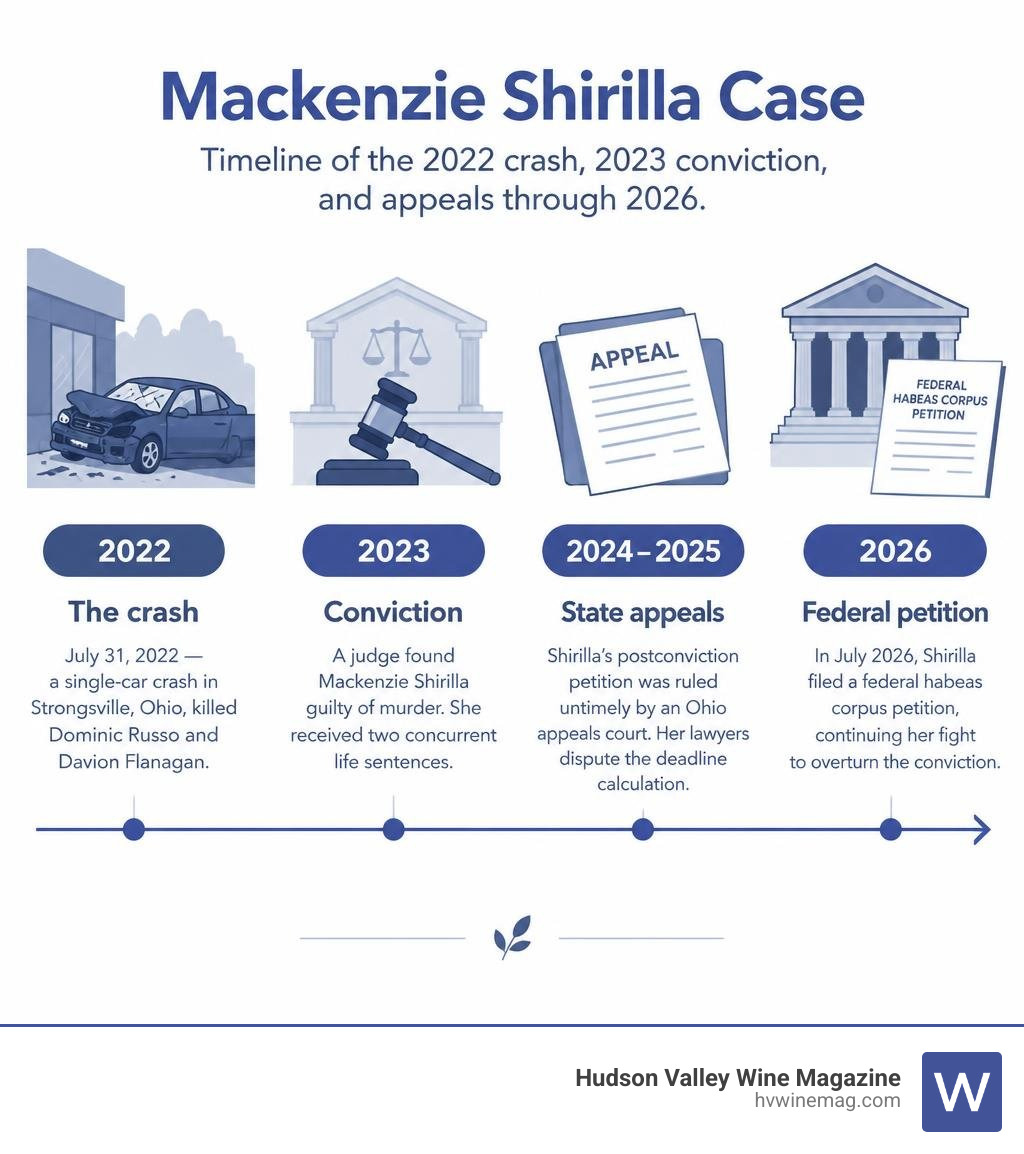
Mackenzie Shirilla was convicted of murder in 2023 after a judge found that she intentionally drove into a building in Strongsville, Ohio, killing her passengers, Dominic Russo and Davion Flanagan. She received two concurrent life sentences and can seek parole in October 2037.
The case is still being challenged. Shirilla argues that her lawyers failed to fully investigate whether a medical condition could explain the crash. An Ohio appeals court ruled that her postconviction petition was filed too late. Her lawyers dispute how that deadline was calculated, and she filed a federal habeas corpus petition in July 2026.
While Hudson Valley Wine Magazine typically covers New York’s wine and craft beverage scene, we also examine complex legal stories that shape national conversations. This guide explains the verdict, the evidence, and the ongoing appeals in the Mackenzie Shirilla case.
Key Facts and Trial Evidence in the Mackenzie Shirilla Case
The tragedy occurred in the early morning hours of July 31, 2022, at approximately 5:30 a.m. in the Cleveland suburb of Strongsville, Ohio. Mackenzie Shirilla, who was 17 years old at the time, was behind the wheel of a 2018 Toyota Camry carrying her 20-year-old boyfriend, Dominic Russo, and 19-year-old friend Davion Flanagan.
What initially seemed like a devastating single-car accident quickly escalated into a high-profile criminal investigation. First responders and forensic teams reconstructed a terrifying sequence of events that contradicted the typical hallmarks of an accidental collision, as outlined in investigation details by NBC News.
Crash Dynamics and Event Data Telemetry
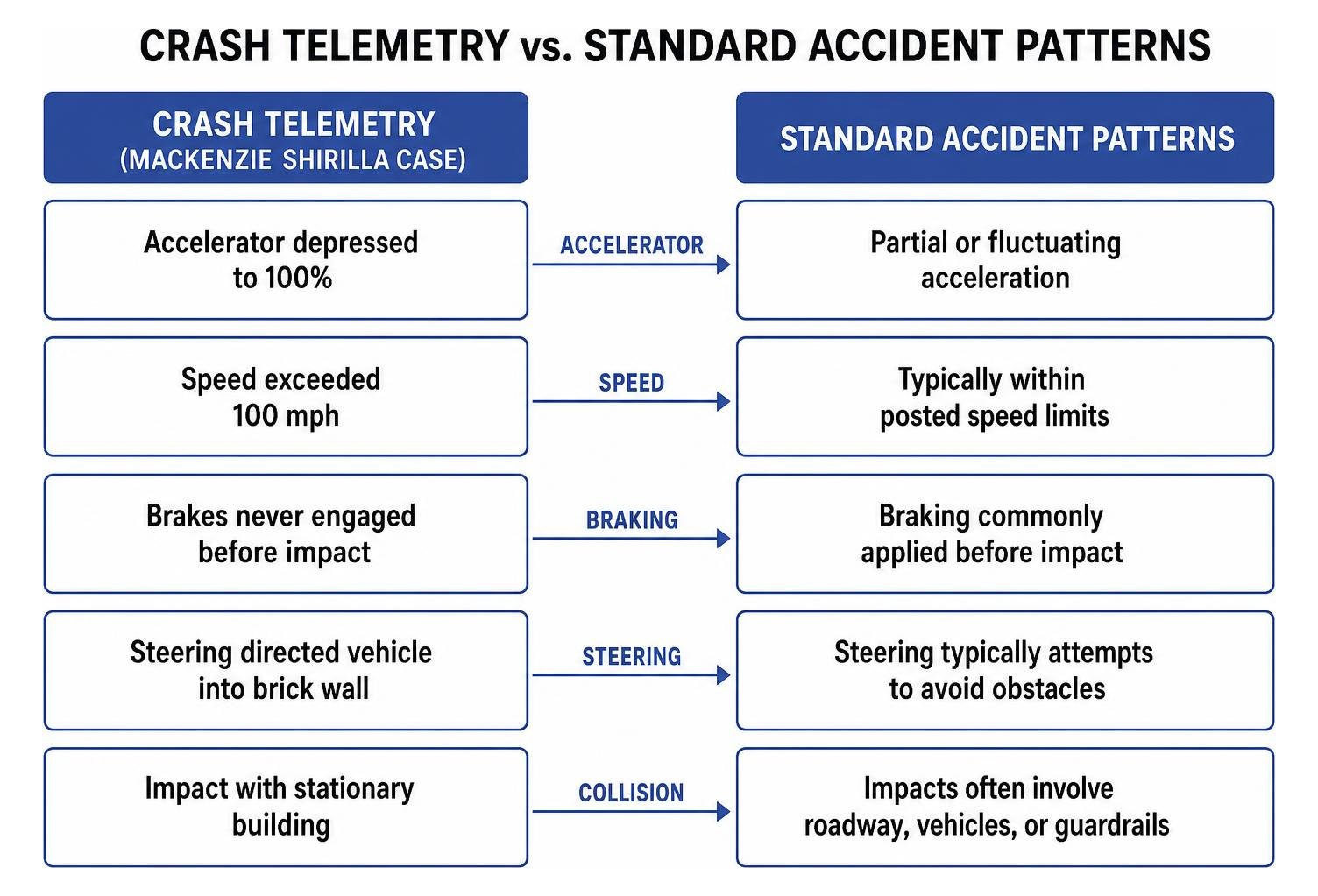
The physical telemetry extracted from the Toyota Camry’s Event Data Recorder (EDR)—often called the vehicle’s “black box”—became the cornerstone of the state’s prosecution.
The EDR recorded that seconds prior to the collision:
- The accelerator pedal was depressed to 100% of its travel capacity.
- The vehicle reached a top speed exceeding 100 mph (160 km/h) down a narrow commercial street designed for low speeds.
- The vehicle’s braking system was never engaged at any point leading up to the impact.
- The steering wheel was turned deliberately to direct the car directly into the brick wall of the Plidco building.
Because the crash occurred in a quiet business park during the pre-dawn hours, the mangled wreckage sat undiscovered for roughly 45 minutes until a passerby spotted the vehicle and notified emergency services. Russo and Flanagan died instantly upon impact from massive blunt force trauma. Shirilla survived with severe injuries.
Premeditation and Motive Evidence in the Mackenzie Shirilla Case
Prosecutors argued that Shirilla’s actions were not merely reckless, but represented a calculated, premeditated act of murder. To prove purposeful intent beyond a reasonable doubt in the bench trial, the prosecution introduced extensive digital evidence and witness testimony regarding the couple’s relationship.
The court examined a series of past altercations, including a video recorded by Dominic Russo weeks prior where Shirilla could be heard threatening to damage his property and aggressively confronting him during an argument. Witnesses testified that Shirilla had made alarming statements during previous relationship disputes, including threatening to crash the vehicle while driving with Russo.
Digital forensics revealed that Shirilla had visited the exact commercial complex where the crash occurred multiple times in the days preceding the collision, suggesting a pre-planned route. In addition, officers recovered psilocybin mushrooms and a digital scale from the vehicle, supporting additional felony charges. The prosecution also highlighted her social media persona and past statements, arguing they demonstrated a callous disregard for human life.
The Murder Conviction, Sentencing, and POTS Medical Claims
In August 2023, Cuyahoga County Common Pleas Judge Nancy Margaret Russo found Shirilla guilty of 12 felony counts, including four counts of murder, four counts of felonious assault, two counts of aggravated vehicular homicide, drug possession, and possessing criminal tools.
During the verdict reading, Judge Russo characterized Shirilla’s conduct as “hell on wheels,” emphasizing that the teen had executed a deliberate “mission” of death. Shirilla received two concurrent terms of 15 years to life, along with an indefinite suspension of her driver’s license.
Juvenile Transfer and Adult Sentencing
Because Shirilla was 17 years old at the time of the offense on July 31, 2022, the case initially originated within the juvenile court system. Following her arrest in November 2022—details of which are documented in the arrest timeline and custody background—prosecutors filed a motion to transfer jurisdiction to adult court.
Following a mandatory bindover proceeding, the juvenile judge determined there was probable cause to try her as an adult given the gravity of the offenses. After her conviction at age 19 in adult common pleas court, she was remanded to the Ohio Reformatory for Women in Marysville to begin serving her sentence.
Postural Orthostatic Tachycardia Syndrome and Defense Omissions
In her postconviction filings, Shirilla’s appellate attorneys introduced a central defense that was not fully developed during the original bench trial: her diagnosis of Postural Orthostatic Tachycardia Syndrome (POTS).
POTS is a disorder of the autonomic nervous system characterized by sudden heart rate spikes, blood pressure drops, dizziness, and sudden syncope (loss of consciousness). Her appellate counsel asserted:
- Trial counsel rendered ineffective assistance under the Sixth Amendment by failing to retain expert medical witnesses to testify about POTS.
- A sudden syncope episode could cause a driver’s foot to lock against the accelerator while losing conscious control of the steering wheel and braking functions.
- This underlying medical reality directly challenges the prosecution’s theory of conscious premeditation.
Procedural Appeals and Ohio Appellate Division Over Transcript Deadlines
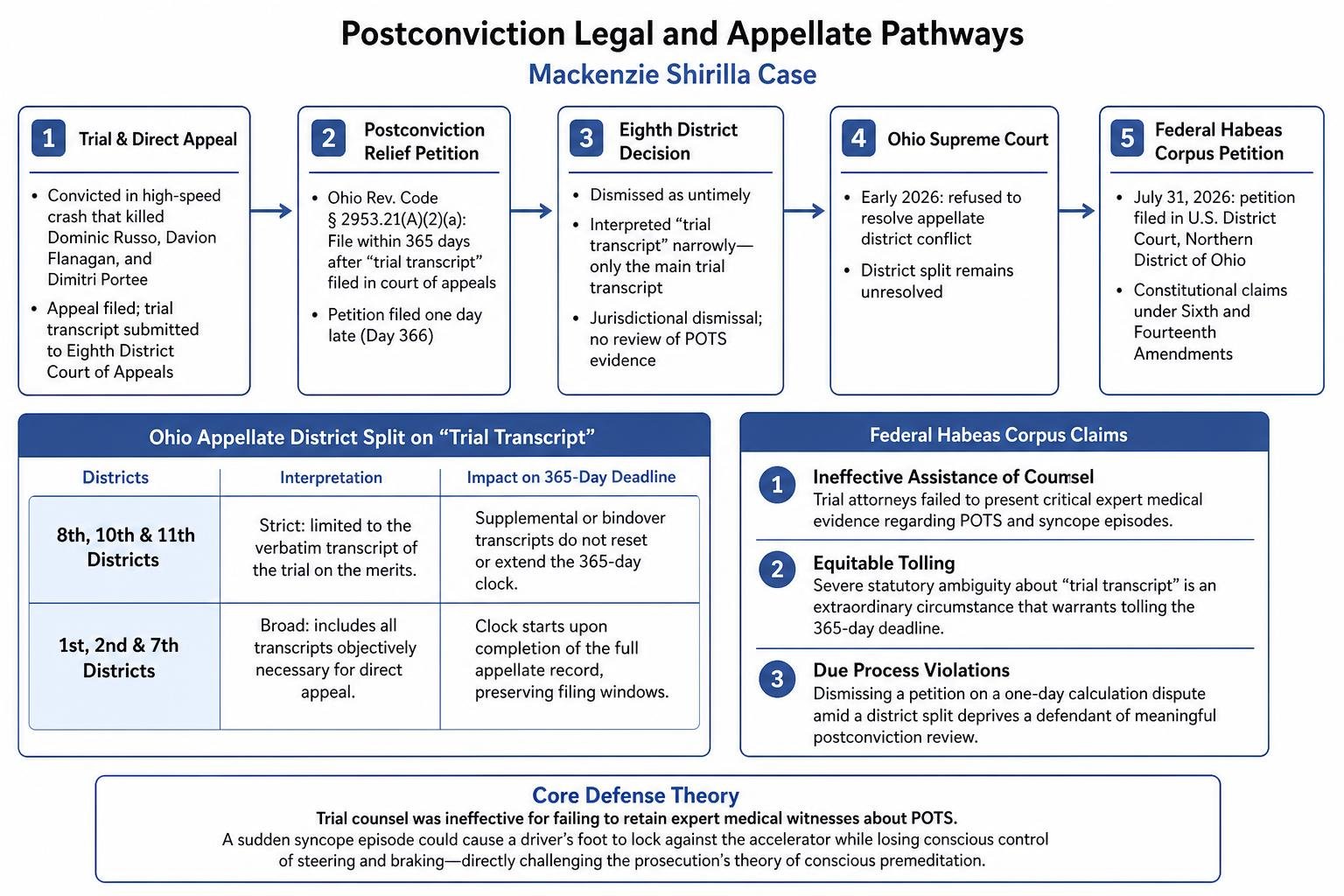
Under Ohio Revised Code § 2953.21(A)(2)(a), a petition for postconviction relief must be filed no later than 365 days after the date on which the “trial transcript” is filed in the court of appeals in the direct appeal.
When Shirilla’s legal team filed her postconviction relief petition, Cuyahoga County’s Eighth District Court of Appeals dismissed it as untimely. The appellate court calculated the 365-day deadline strictly from the filing date of the main trial transcript, concluding that the petition was submitted one day late (on day 366).
| Ohio Appellate District | Statutory Interpretation of “Trial Transcript” | Impact on Filing Deadlines |
|---|---|---|
| 8th, 10th & 11th Districts | Strictly limited to the verbatim transcript of the trial on the merits. | Supplemental or bindover transcripts do not reset or extend the 365-day clock. |
| 1st, 2nd & 7th Districts | Broad interpretation: includes all transcripts objectively necessary for direct appeal. | Clock starts upon completion of the full appellate record, preserving filing windows. |
Ohio Appellate Conflict and Transcript Disputes in the Mackenzie Shirilla Case
This split among Ohio appellate districts created a significant procedural barrier. Shirilla’s appellate team argued that the record was not complete until the juvenile bindover hearing transcript was formally transmitted on December 15, 2023. Because the bindover record was an essential component cited throughout the appeal, the defense maintained that the 365-day statutory window should run from that final necessary filing.
Under the broader standard applied in the First, Second, and Seventh Districts, her petition would have been deemed timely. However, under the Eighth District’s narrow view, the postconviction claim was dismissed on jurisdictional grounds, preventing a substantive judicial review of the POTS evidence, as noted in this overview of rejected appeals.
Equitable Tolling and Federal Habeas Corpus Petition
Following the Ohio Supreme Court’s refusal to resolve the appellate district conflict in early 2026, Shirilla’s defense turned to the federal court system. On July 31, 2026, her attorneys filed a formal petition for a writ of habeas corpus in the U.S. District Court for the Northern District of Ohio.
As outlined in habeas corpus appeal filing details, the federal petition raises critical constitutional claims under the Sixth and Fourteenth Amendments:
- Ineffective Assistance of Counsel: Trial attorneys failed to present critical expert medical evidence regarding POTS and syncope episodes.
- Equitable Tolling: The defense argues that severe statutory ambiguity regarding the definition of a “trial transcript” constitutes an extraordinary circumstance that warrants tolling the strict 365-day filing deadline.
- Due Process Violations: Dismissing a petition on a one-day calculation dispute when appellate districts are divided deprives a defendant of meaningful postconviction review.
Cultural Fallout, Victim Impact, and ‘The Crash’ Documentary
The case attracted widespread public attention, further amplified by true-crime podcasts and streaming media, including the Netflix docuseries The Crash. The documentary re-examined the forensic telemetry, public reactions, and opposing viewpoints surrounding the verdict.
Shirilla’s father, Steve Shirilla, has publicly asserted that the crash was not an act of murder. In media appearances, he argued that had his daughter harbored violent intent, she would not have chosen a high-speed vehicle collision that carried a near-certain risk of her own death, as highlighted in this summary of the father’s statements and defense theory.
Flanagan and Russo Families’ Pursuit of Justice
For the families of Dominic Russo and Davion Flanagan, the ongoing appeals and media productions have reopened profound emotional wounds. Both families have remained steadfast in their belief that justice was properly served by the trial court’s verdict.
To honor their sons, the families have turned grief into community action:
- Davion Flanagan Memorial: Establishments of academic and athletic memorial scholarships to support local students.
- Russo Family Advocacy: Dominic’s sister launched The Big Sister: Unhinged podcast, addressing grief, trauma, and domestic relationship dynamics.
During court proceedings, both families delivered powerful impact statements emphasizing the lifelong absence left by the sudden loss of two young men on the cusp of adulthood.
Parental Defense and Incarceration Reality
Inside the Ohio Reformatory for Women, Shirilla maintains a routine centered around a food-service job that earns up to $24 per month, while pursuing self-improvement goals and expressing long-term aspirations to work as a life coach.
Her legal team continues to push for a complete retrial through federal litigation, documented in ongoing reports on her challenges and new trial requests. Her first opportunity to appear before the Ohio Parole Board is scheduled for October 2037.
Frequently Asked Questions About the Legal Proceedings
Why was Mackenzie Shirilla convicted of murder rather than vehicular manslaughter?
The court found that Shirilla acted with purposeful intent rather than mere criminal recklessness. This finding was supported by Event Data Recorder telemetry showing 100% accelerator depression with zero brake application, past verbal and physical threats against Dominic Russo, and GPS records showing prior visits to the crash location.
When will Mackenzie Shirilla become eligible for parole?
Shirilla was sentenced to two concurrent terms of 15 years to life. Her first statutory parole eligibility date arrives in October 2037, at which point the Ohio Parole Board will evaluate her institutional conduct and suitability for release.
How does the ‘trial transcript’ dispute affect Ohio postconviction relief?
Under R.C. 2953.21(A)(2)(a), postconviction petitions must be filed within 365 days of the trial transcript filing. A jurisdictional split exists across Ohio: some districts calculate the deadline strictly from the trial record, while others include supplemental transcripts like bindover hearings. This split determines whether Shirilla’s petition is procedurally barred or eligible for substantive judicial review.
Conclusion
The legal battles surrounding the Mackenzie Shirilla verdict highlight the intersection of digital forensics, medical defenses, and procedural state law. As federal courts evaluate her July 2026 habeas corpus petition, the broader question of how Ohio defines statutory filing deadlines remains an important issue for statewide appellate practice.
While we typically focus on exploring our region’s rich culture—from scenic travel guides to exploring regional destinations like Angry Orchard Cider House—we also recognize the value of unpacking complex legal and social stories that shape national conversations. As federal proceedings progress, the case continues to serve as an important study in modern criminal jurisprudence.