When it comes to real estate, sometimes the property chooses you. For Michael Dorf, that moment came with a kind of uncanny symmetry that felt like fate. While searching for a larger production facility for City Winery, his winery-music venue-restaurant concept with 15 locations nationwide, all in major urban centers, Dorf found himself face to face with an actual knitting factory. The founder of New York City’s former Knitting Factory nightclub had discovered Montgomery Mills.
After touring everything from an old prison to a former laboratory complex to a handful of horse farms, Dorf came across the old Montgomery Worsted Mills yarn factory — situated on none other than Factory Street.
“When I saw the Montgomery Mills sign next to Factory Street, I connected the dots,” Dorf says. “I realized, ‘Oh my God, I discovered the Knitting Factory.’ It had this deeper, karmic connection for me.”
The parallel wasn’t lost on him. Back in 1986, when Dorf named his original club Knitting Factory, the phrase itself felt like an oxymoron, pairing something handmade with something industrial. But that raw DIY aesthetic eventually became part of the venue’s DNA, shaping a 36-year run that helped launch the careers of countless musicians, comedians, and performers across genres.
By the time that chapter came to a close, Dorf’s vision had already evolved. What he found in Montgomery wasn’t just a new site, but an opportunity to carry that ethos forward, transforming a once-active industrial space he later described as “a junkyard” into something entirely new: a 22-acre winery destination where creativity, craft and heritage converge in the Hudson Valley.
Transforming A Historic Industrial Backbone Into Live Modern Venue
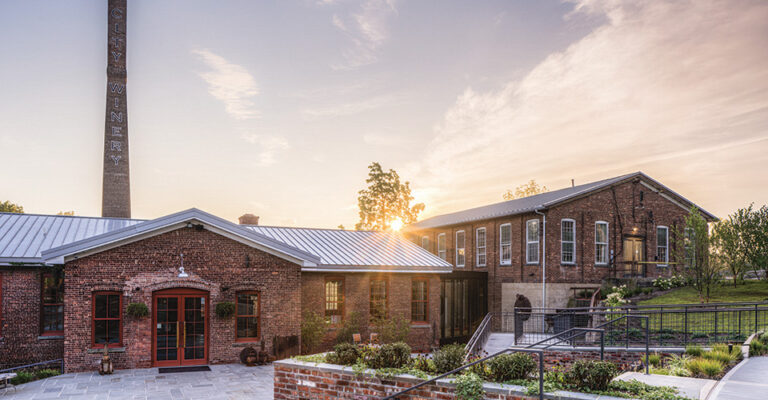
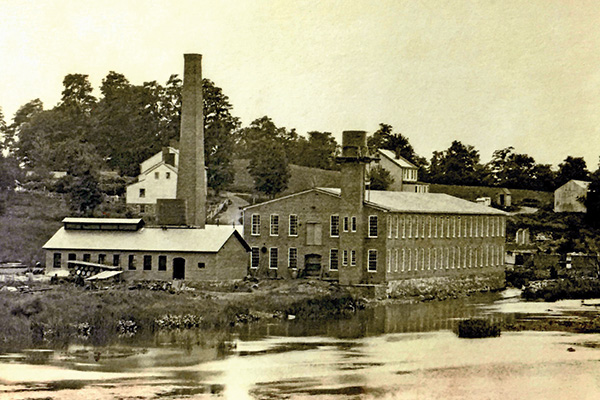
At a time when many adaptive reuse and reconstruction projects look nearly identical, what’s striking about the Montgomery Mills property is how little has been erased. The main factory floor where yarn was once made now houses City Winery’s weddings and concerts, while original dam spine turbines that operated the building’s primitive fan air conditioning remain in the ceiling as a beautiful nod to the past.
Originally built in 1813 as a grist mill, the site originally served as a flour and cotton gin before it was eventually rebuilt into Montgomery Worsted Mills: a factory spinning wool into yarn using a hydro-powered system from the dam on the Wallkill River. Over time, the property shifted hands before falling into disrepair, requiring a labor of love to bring it back to life.
When Dorf assumed ownership, he insisted on retaining as much original infrastructure as possible. Rather than gut the space entirely, the team incorporated original cast iron machines, leather belts, and structural elements throughout the property into bars, tables, and other visual anchors that still hint at their original function.
“We kept everything original, except for the windows, doors, and electrical, says General Manager Fletcher Tingle. “Pretty much everything else is as it was when we bought it.”
For Dorf, that continuity isn’t just aesthetic. The original Knitting Factory was housed in an old print shop. The original City Winery had beams over 300 years old. The history of the materials and depth of the imperfections are a very meaningful part of adaptive reuse, he says, giving the space its weight: authentic craftsmanship and an irreplicable sense of time.
“To think that those pieces of wood were around before the American Revolution is really powerful,” Dorf says. “I think about that when an artist like Patti Smith, David Byrne or Lou Reed was on our stages and how that vibe helps make the space, even if it’s unconscious or people aren’t thinking about it.”
The Art of Winemaking
If the Montgomery Mills building reflects the past, the wine program looks outward. No single vineyard defines the portfolio at City Winery, which includes grapes from top vineyards in Napa Valley, Willamette Valley and the Central Coast, and neighbors in the Finger Lakes and Hudson Valley.
Winemaker Travis Van Caster’s approach is simple: start with strong ingredients and interfere as little as possible. “We believe in using the best raw ingredients to craft our wines,” he says.
After years of working in large-scale production environments where he estimates having made roughly 3% of the national wine production, Van Caster was drawn to the Hudson Valley for the opposite reason: the ability to work more intuitively, without rigid expectations, and surrounded by a diverse community of forward-thinking creatives.
“I have been so blown away by the food and beverage scene in the Hudson Valley from other wine makers, cidermakers, spirits makers, and the chefs out here. It’s really an incredible place full of creative people,” he says.
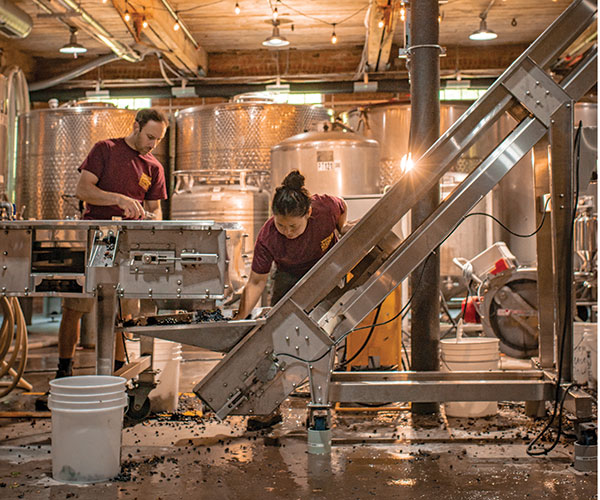
The flexibility in his winemaking is intentional. Many of his wines are unfined and unfiltered for that reason, with native yeasts used whenever possible and additives kept to a minimum. The goal isn’t to manipulate the wine into a specific profile, he says, but to preserve what’s already there — even if it takes a few extra steps. “On some level, we do it because we can,” he says.
The result is a portfolio driven by conscious experimentation. Along with City Winery’s more approachable varietals, it’s not uncommon to catch releases like a Riesling Vin de Glacière, crafted with cryo-extraction and slow oak barrel fermentation, alongside an orange wine using Albariño grapes or a Zinfandel port from the Russian River Valley that was aged three years in French oak followed by three months aged in Jamaican rum barrels. In one project, Van Caster used the same Sauvignon Blanc aged in concrete, stainless steel, and oak, then presented to guests individually and as a blend to experience how each method shapes the final wine.
Lately, Van Caster has taken a shine to New York wines, including a recent vintage made in a carbonic style using Hudson Valley Gamay.
“You start with 100 percent of your potential quality in the vineyard,” Van Caster says. “Every step along the way, you have the potential to lose quality.” That same thinking extends to sustainability. Most of the wine produced at City Winery — roughly 70% — never goes into the bottle. Instead, it’s transferred to stainless steel kegs and served on tap to retain freshness, eliminating the need for glass, corks, and excess packaging. Any wines that are bottled use lightweight glass and skip traditional capsules — small changes that collectively reduce waste.
“It’s better for the environment, but it’s also better for the wine. It goes from barrel to glass much faster,” he says. “Our target is to make the very best wine you can, whatever that means. There’s a lot of room to be creative and play.”
Creativity in the Kitchen
Like everything at City Winery Hudson Valley, food works in tandem with its wine and event programming counterparts. Led by Executive Chef Tony Moustakas, the culinary program designs dishes with specific wines in mind, shifting menus depending on what’s available, what’s working, what feels worth exploring.
At the center of that relationship is the Chef & Winemaker Dinner series, where Moustakas and Van Caster pair four-course menus with wines selected (and sometimes created) specifically for the experience. Throughout the dinner, both the chef and the winemaker personally walk the room, interacting with guests to help them understand how the pairing works and why.
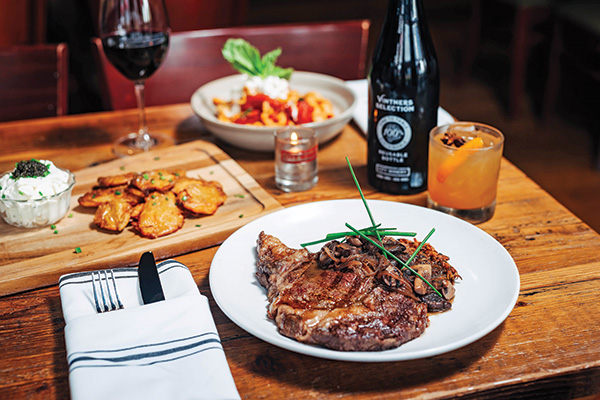
When the series first launched, it was small. Very small. “Our first dinner, we had two people show up,” Van Caster says. “Now we’re at the point where we have to cap ticket sales.” Over time, these dinners have built their own following with repeat guests returning not just for the food or wine, but for the joint experience. Behind the scenes, the popularity of these events at the Hudson Valley location has quietly become a testing ground influencing the broader City Winery ecosystem.
Beyond the Winery: Music, Art and Community
City Winery Hudson Valley doesn’t behave like a traditional winery. There’s no singular tasting room experience and no fixed path through the property. In reality, it functions more like a series of overlapping systems: Come for a tasting, end up at a concert. Book dinner, then realize halfway through that there’s live music a few feet away. You can even spend an afternoon walking the property without stepping into the main building at all.
Part of that is structural. Unlike the brand’s urban locations, Hudson Valley has physical space to expand, to experiment, to host different types of events that engage with more directly with the surrounding community without compressing them into a single format. Weekly events, seasonal festivals, and recurring dinners create multiple ways for people to engage with the space.
Music remains central to the experience. Ticketed performances continue to draw in national touring acts, such as Lyle Lovett and Billy Bragg, but there’s also a steady rotation of free shows featuring local talent.
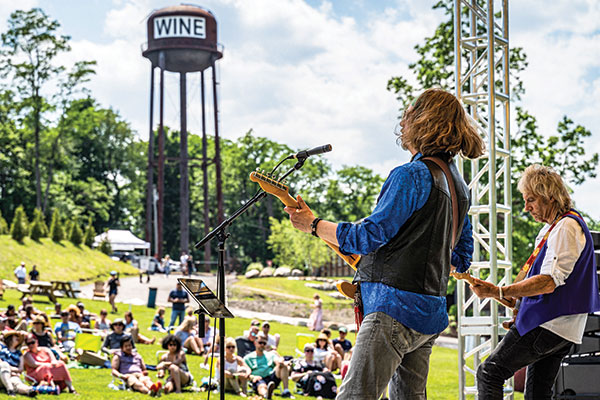
“There is so much creativity happening here in our region, with a pipeline of young, eager artists of all different mediums and styles,” Tingle says. “Most of our daily players are local. We’ve got a great customer base of people following us to see who’s coming up on stage next.”
And in case you’re wondering, music shows up in the winemaking process, too.
“There’s always some tie to music in our label design,” says Van Caster. “We have a port called The Encore, and the label is this dark, brooding painting of a man playing a cello. As somebody who enjoys the privilege of being creative and the opportunity to make things, it’s been very important to me to give our design team agency to be creative.”
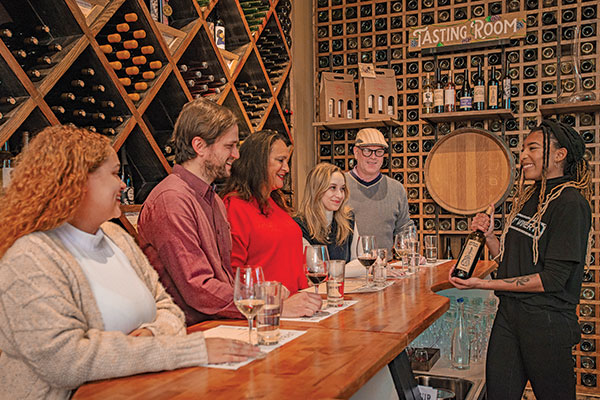
For all its moving parts, the goal is relatively simple: to give people a reason to stay a little longer, to come back, and to bring someone else with them next time. “I want people to feel cared for,” Tingle says. “Refreshed. Excited about what’s next.”
In a region that’s increasingly defined by its ability to balance growth with character, City Winery Hudson Valley fits naturally into the landscape. Not as a departure from what’s already there, but as an extension of its evolution, just as the mill once did. •
Photos courtesy of City Winery Hudson Valley.